reference · edge
What Is an Edge Gateway? Architecture, Roles, and Selection
See an original field-to-cloud edge gateway architecture, compare gateway and edge-computer roles, and choose safe protocol, buffering, and control boundaries.
Version, source checks, and technical review
- For
- What Is an Edge Gateway? Architecture, Roles, and Selection
- Published
- Version
- See primary sources for versions
- Facts and sources
- Checked against the cited sources on Sep 4, 2026
- Technical review
- No independent technical review recorded
Conclusion first
The decision in one paragraph
An edge gateway should absorb field constraints and preserve safe operation—not become an unbounded second cloud platform.
The short answer
An edge gateway should absorb field constraints and preserve safe operation—not become an unbounded second cloud platform.
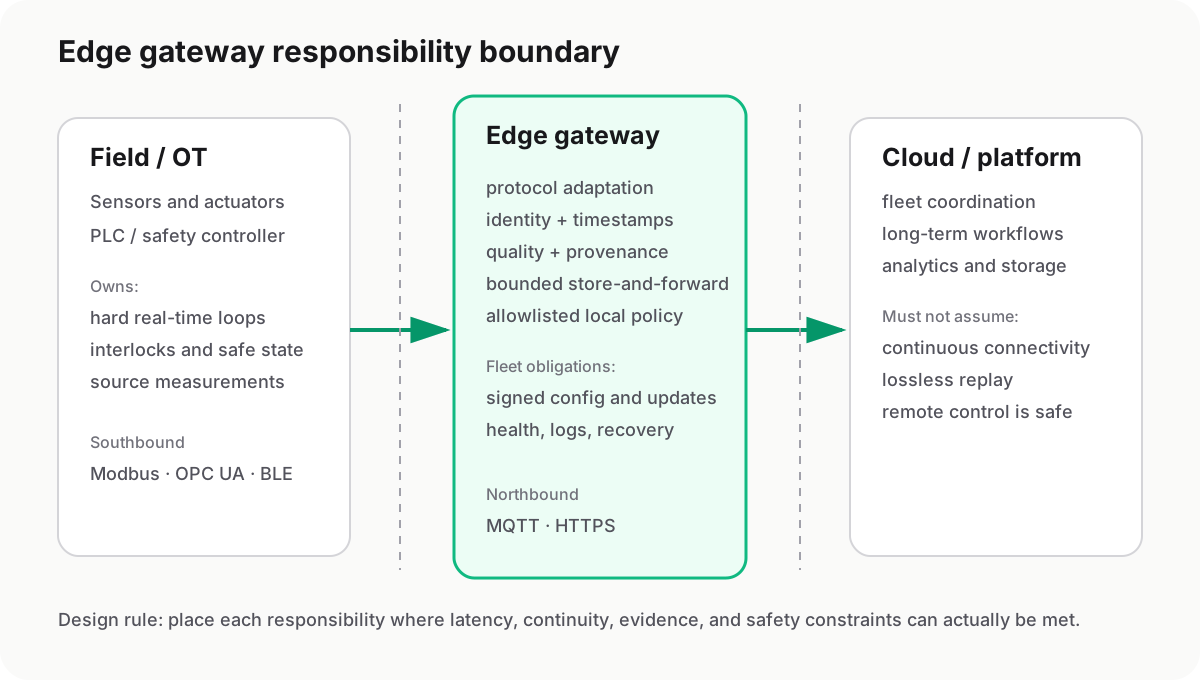
An edge gateway sits between field equipment and broader platform or enterprise systems. It may adapt protocols, normalize data, buffer during outages, enforce local policy, and host limited computation near the process. Its purpose is to contain boundary complexity and preserve required local behavior. Because it is deployed in the field, every added service also becomes software that must be secured, observed, updated, and recovered across a fleet.
Why gateways exist
Industrial and building devices often use serial buses, proprietary protocols, or local timing that cloud services cannot address directly. Sites may have intermittent backhaul, strict segmentation, or data that should not leave the facility in raw form. A gateway can poll equipment, attach context and quality, and publish a stable northbound contract.
It can also preserve bounded operations during cloud loss. That does not mean copying the entire cloud platform to every site. The edge should own only responsibilities whose latency, continuity, bandwidth, privacy, or safety constraints justify local execution.
How it works
Southbound adapters communicate with field devices through protocols such as Modbus, OPC UA, BLE, or vendor interfaces. Acquisition schedules reflect process dynamics and bus capacity. The gateway timestamps observations, preserves source quality, and maps them into a versioned device or asset model.
A store-and-forward layer buffers selected data when northbound connectivity is unavailable. Each record needs source time, ingestion time, identity, schema version, quality, and ordering context. Buffers require size limits, retention priorities, and a policy for what happens when storage fills. Replaying stale commands after reconnect is usually unsafe; telemetry replay and command recovery need different rules.
Northbound clients publish events or expose APIs to platform services. Identity should distinguish the gateway from downstream assets and record when the gateway is asserting data on their behalf. Credentials and permissions should be scoped by site, protocol, and operation.
Local applications may filter signals, aggregate data, run approved inference, or coordinate a defined procedure. A supervisor should manage resource limits, health, restart, and dependencies. Configuration and software updates need signatures, compatibility checks, staged rollout, rollback, and an out-of-band recovery path.
What a gateway solves
A gateway can isolate field protocols, reduce bandwidth, provide offline buffering, centralize site connectivity, and create a manageable security boundary around legacy devices. It can expose consistent data without requiring every cloud service to understand every register map.
It is also a practical point for site-level observability: bus errors, device reachability, queue depth, disk health, transformation errors, and northbound latency.
What it does not solve
A gateway does not make an insecure field protocol secure end to end. It can restrict access and add a secure northbound connection, but compromised gateway credentials may still reach controllers. Network segmentation, allowlisted writes, local interlocks, and host hardening remain necessary.
It does not guarantee semantic correctness. A transformation can attach the wrong unit or map the wrong register while every transport reports success. Preserve raw evidence and version maps so operators can diagnose that class of failure.
Where it fits—and where it does not
Use a gateway when many local devices share backhaul, when field protocols need adaptation, or when the site requires offline continuity. Direct device-to-cloud connectivity may be simpler for capable products with reliable networks and no shared site context.
Keep hard real-time and functional-safety loops in dedicated controllers. A gateway can observe or request bounded operations, but a general-purpose OS and remotely updated application stack should not become the only safety barrier.
Edge gateway vs edge computer vs API gateway
These labels overlap in product marketing, so choose from responsibilities rather than names.
| Component | Primary boundary | Typical work | A poor fit when |
|---|---|---|---|
| Edge gateway | Field/OT protocols to platform contracts | protocol adaptation, identity, quality, buffering, scoped local policy | the task is only HTTP API routing |
| Edge computer | Compute close to a process or data source | video inference, analytics, local application workloads | no local compute, latency, privacy, or continuity need exists |
| API gateway | Application clients to service APIs | routing, authentication, quotas, request transformation | serial buses, device timing, offline buffering, or site recovery are required |
| Industrial controller | Deterministic process and safety control | real-time logic, interlocks, safe state | the workload is fleet analytics or general application hosting |
A device can combine several roles, but the operational boundaries still matter. If one appliance runs a PLC runtime, protocol adapters, containers, VPN access, and cloud agents, document and isolate each trust zone, update path, failure mode, and owner.
Selection checklist
Start with the field interface inventory and worst credible operating condition, not CPU specifications. Record protocol variants, device counts, polling rates, timing tolerance, data quality, expected outage duration, storage budget, environmental rating, lifecycle, and who can physically service the site.
Then define the northbound contract: stable asset identity, schema version, units, source and receipt time, quality, deduplication key, ordering context, security identity, and replay behavior. Size storage from the selected retention policy and outage model. “Large disk” is not a buffer policy.
Evaluate fleet operations before selecting the application stack. Require secure boot where the threat model calls for it, signed software and configuration, staged rollout, health checks, remote diagnostics, credential rotation, rollback compatible with data migrations, and a tested factory or out-of-band recovery path. Use the edge-vs-cloud boundary guide to assign individual workloads.
Failure scenarios to test
- Cloud loss: local acquisition and explicitly approved local behavior continue within bounds; queues expose depth, age, and overflow policy.
- Storage full: priority and retention rules decide what is dropped; control must not fail unpredictably because telemetry storage filled.
- Gateway reboot during replay: deduplication and ordering context prevent silent duplication or reordering.
- Bad mapping update: versioned mappings and retained raw evidence make unit or register errors diagnosable and reversible.
- Credential compromise: site-, protocol-, asset-, and operation-scoped permissions contain impact; local interlocks still hold.
- Partial southbound failure: one unavailable bus or asset does not turn cached values into current truth.
- Fleet update failure: staged rollout pauses automatically, preserves a recovery route, and does not strand every site on the same broken release.
Related technologies
Modbus and OPC UA are common southbound interfaces. MQTT and HTTPS often serve northbound exchange. Containers can package edge workloads but add image, runtime, storage, and orchestration responsibilities. Device identity, OTA, observability, and zero-trust policy apply to gateways as managed products.
Common misconceptions
“Edge means low latency” ignores acquisition, scheduling, and application delays. “A container platform makes the edge a small cloud” ignores field recovery and limited staff. “Buffered data can always be replayed” ignores relevance and ordering. “One gateway credential is enough” hides downstream identity. “Remote access is maintenance” can become an undocumented permanent trust path.
Define ownership for hardware replacement, local data, configuration, certificates, updates, logs, and factory reset. A gateway without a fleet operating model is an unmanaged server installed beside critical equipment.
Before you ship
Implementation checklist
- Define behavior for cloud loss and partial connectivity.
- Use signed configuration and staged updates.
- Keep raw evidence for diagnosing transformations.
Primary sources
Verify the facts
- NIST SP 800-82 Rev. 3 — Guide to Operational Technology SecurityAccessed Sep 4, 2026
Sources checked Sep 4, 2026 · Next check due: September 4, 2027
Maintenance
Update history
- Jul 14, 2026
- First published
- Sep 4, 2026
- Content updated and sources checked
Tell us when an explanation is unclear, inaccurate, or outdated.